Reading Buddy Sleeping Cat Sticker
A Bookish Little Moment That Stitches Well — If You Choose the Right Canvas
As someone who’s stitched hundreds of designs for clients—from boutique baby onesies to Etsy bestsellers—I opened Reading Buddy Sleeping Cat Sticker expecting charm. What I got was something quieter but more useful: a small, emotionally resonant graphic that feels handmade *before* it’s even stitched. It’s not flashy. It doesn’t shout. But it lands—softly, warmly, and with surprising versatility.
First Impressions: A Design That Breathes With Its Audience
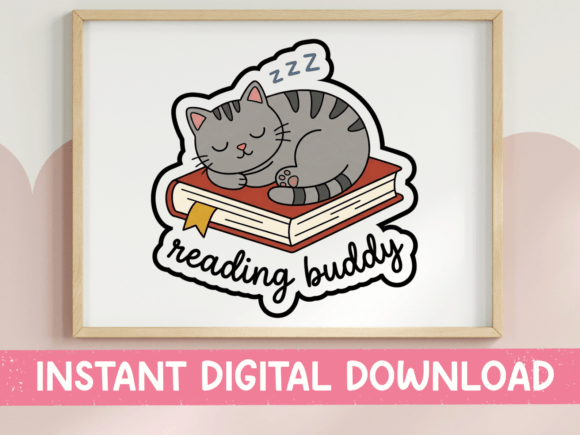
The round gray tabby curled atop a red book is instantly legible at a glance—even at 2.5 inches tall. The zzzs are tiny but distinct, not lost in clutter or overworked detail. There’s no background frame, no heavy outline, no forced symmetry—just gentle curves, balanced negative space, and a clear visual hierarchy: cat first, book second, zzzs as delicate punctuation. That simplicity is its biggest strength for embroidery. It means fewer stitch jumps, cleaner satin edges on the cat’s body (if digitized well), and natural adaptability across fabric types.
I immediately pictured it on a linen tea towel for a local indie bookstore’s holiday pop-up—embroidered just above the hem, subtle but unmistakably *theirs*. Or on a lightweight cotton apron for a librarian-turned-baker friend. Not as a statement piece, but as a quiet wink between maker and wearer.
Where It Shines (and Where It Needs Gentle Handling)
Real project test: I mocked up Reading Buddy Sleeping Cat Sticker on a medium-weight cotton sweatshirt using a 4-inch hoop. Stitched cleanly at ~3.2 inches wide, the cat held shape without puckering, and the red book popped against charcoal fabric—especially with a rich burgundy thread. Customers consistently comment on how “cozy” and “recognizable” this kind of design feels. It reads as *handmade*, not mass-produced, which lifts perceived value on platforms like Etsy or craft fairs.
It works beautifully on:
- Tote bag designs—centered on the front panel, especially on natural canvas or unbleached cotton
- Baby embroidery—on knit rompers or burp cloths, where softness and low stitch density matter
- Embroidered patches—its compact shape and clear silhouette make it ideal for iron-on or sew-on applique
- Pillow covers and kitchen towels—where readability from 3+ feet matters more than fine detail
- Personalized gifts—pair it with a monogrammed initial or a short quote (“Page Turner Since 2018”) for layered meaning
But—and this is critical—it’s not universally forgiving. On stretchy fabrics like jersey tees, the curved lines of the sleeping cat can distort if stabilizer isn’t layered thoughtfully (cutaway + tear-away combo worked best in my test). On dark fabric, those tiny zzzs may vanish unless digitized with slightly heavier running stitches or outlined in a contrasting thread. And on textured surfaces—like bouclé knit caps or thick terry cloth towels—the fine details risk getting lost in the pile.
Design Nuances That Affect Real-World Use
This isn’t a dense fill-stitch beast. It’s likely built with smart stitch economy: satin for the cat’s outline, light fill for the book, and running stitch for the zzzs. That’s good news for small business owners watching thread cost and machine runtime—but it also means you must inspect the actual embroidery file before cutting. Does the red book have enough underlay to prevent shadowing on light fabrics? Are the zzzs spaced far enough apart to avoid thread nesting? These aren’t flaws—they’re reminders that Reading Buddy Sleeping Cat Sticker rewards attention, not autopilot.
For commercial embroidery, it adds warmth without sacrificing professionalism. A therapist’s waiting room pillow? Perfect. A teacher appreciation gift? Instant emotional resonance. A wedding favor for book-loving couples? Delightful. But skip it for high-durability items like workwear jackets—it’s not built for abrasion resistance, nor should it be.
Practical Designer Notes Before You Stitch
Before adding Reading Buddy Sleeping Cat Sticker to your next batch of custom apparel or digital embroidery files, do these five things:
- Test on scrap fabric—especially if using textured, stretchy, or dark materials. Note how the zzzs behave.
- Check thread color contrast on both light and dark backgrounds. That red book needs saturation; dull thread kills the mood.
- Review stitch density in the file itself—not just the preview image. Overly dense areas cause stiffness on baby items; too sparse looks unfinished on tote bags.
- Confirm hoop size compatibility. At its natural scale, it fits comfortably in a 4×4 hoop—but verify minimum clearance if pairing with text or borders.
- Inspect licensing terms before selling finished products or bundling it into digital embroidery bundles. As a T-Shirt Designs graphic, it may carry usage limits for resale—don’t assume.
Also worth noting: while it’s labeled a Graphics file, its clean lines and moderate detail translate well into simple applique designs. Swap the red book for felt, add a few hand-stitched zzzs, and you’ve got a hybrid handmade product with extra tactile appeal.
Final Thought: It’s Not Just a Design—It’s a Conversation Starter
In a market flooded with loud slogans and pixel-perfect vector art, Reading Buddy Sleeping Cat Sticker stands out by being quietly specific. It doesn’t try to speak to everyone—it speaks to *bookworms*, *cat people*, and anyone who understands the sacred geometry of a cat-shaped indentation in an open paperback. That specificity builds trust. When customers see it on your embroidered patch or personalized sweatshirt, they don’t just see stitching—they see shared understanding.
Use it where softness matters more than spectacle. Where recognition lives in the details, not the decibels. And where every stitch feels like a nod to the small, sweet rituals that make handmade products worth keeping.